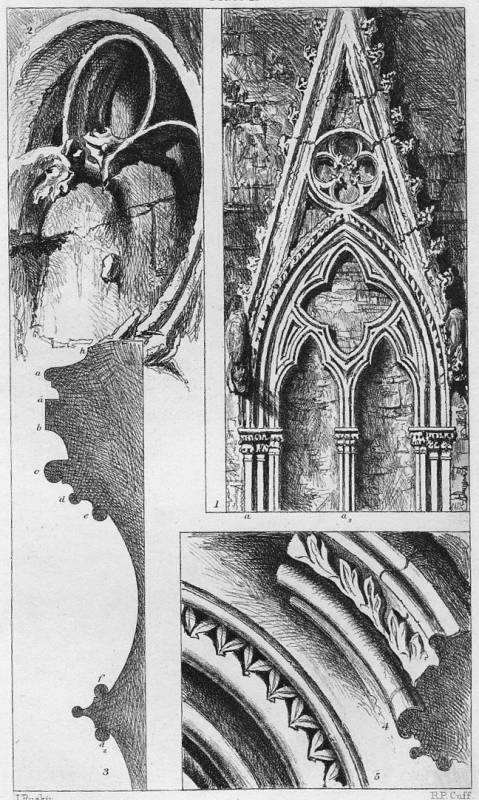
Traceries and Mouldings from Rouen and Salisbury
John Ruskin
R. P. Cuff, engraver
1855
7x 4 3/32 inches
Plate VII, The Seven Lamps of Architecture in Works, 8.165.
According to the "Index to the Plates" (8.xvii), Ruskin refers to this plate on the following passages, which are quoted below:
Related material
Scanned image and text by George P. Landow
[You may use this image without prior permission for any scholarly or educational purpose as long as you (1) credit the photographer and (2) link your document to this URL]

“The Lamp of Beauty”
This rule of supremacy applies to the smallest as well as to leading features; it is interestingly seen in the arrangement of all good mouldings. I have given one, on the opposite page, from Rouen Cathedral; that of the tracery before distinguished as a type of the noblest manner of Northern Gothic (Chap. II. 28). It is a tracery of three orders, of which the first is divided into a leaf moulding, fig. 4 and b in the section, and a plain roll, also seen in fig. 4, c in the section; these two divisions surround the entire window or panelling, and are carried by two-face shafts of corresponding sections. The second and third orders are plain rolls following the line of the tracery; four divisions of moulding in all: of these four, the leaf moulding is, as seen in the sections, much the largest; next to it the outer roll; then, by an exquisite alternation, the innermost roll (e), in order that it may not be lost in the recess, and the intermediate (d), the smallest. Each roll has its own shaft and capital; and the two smaller, which in effect upon the eye, owing to the retirement of the innermost, are nearly equal, have smaller capitals than the two larger, lifted a little to bring them to the same level. The wall in the trefoiled lights is curved, as from e to f in the section; but in the quatrefoil it is flat, only thrown back to the full depth of the recess below so as to get a sharp shadow instead of a soft one, the mouldings falling back to it in nearly a vertical curve behind the roll c. This could not, however, be managed with the simpler mouldings of the smaller quatrefoil above, whose half section is given from g to g2; but the architect was evidently fretted by the heavy look of its circular foils as opposed to the light spring of the arches below: so he threw its cusps obliquely clear from the wall, as seen in fig. 2, attached to it where they meet the circle, but with their finials pushed out from their natural level (h, in the section) to that of the first order (g 2 ), and supported by stone props behind, as seen in the profile, fig. 2, which I got from the correspondent panel on the buttress face (fig. 1 being on its side), and of which the lower cusps, being broken away, show the remnant of one of their props projecting from the wall. The oblique curve thus obtained in the profile is of singular grace. Take it all in all, I have never met with a more exquisite piece of varied, yet severe, proportion and general arrangement (though all the windows of the period are fine, and especially delightful in the subordinate proportioning of the smaller capitals to the smaller shafts). The only fault it has is the inevitable misarrangement of the central shafts; for the enlargement of the inner roll, though beautiful in the group of four divisions at the side, causes, in the triple central shaft, the very awkwardness of heavy lateral members which has just been in most instances condemned. In the windows of the choir, and in most of the period, this difficulty is avoided by making the fourth order a fillet which only follows the foliation, while the three outermost are nearly in arithmetical progression of size, and the central triple shaft has of course the largest roll in front. [pp. 165-66]
Many good architects would insist on abstraction in all cases : the question is so wide and so difficult that I express my opinion upon it most diffidently; but my own feeling is, that a purely abstract manner, like that of our earliest English work, does not afford room for the perfection of beautiful form, and that its severity is wearisome after the eye has been long accustomed to it. I have not done justice o the Salisbury dog-tooth moulding of which the effect is sketched in fig. 5, Plate X., but I have done more justice to it nevertheless than to the beautiful French one above it; and I do not think that any candid reader would deny that, piquant and spirited as is that from Salisbury, the Rouen moulding is, in every respect, nobler. It will be observed that its symmetry is more complicated, the leafage being divided into double groups of two lobes each, each lobe of different structure. With exquisite feeling, one of these double groups is alternately omitted on the other side of the moulding (not seen in the Plate, but occupying the cavetto of the section), thus giving a playful lightness to the whole; and if the reader will allow for a beauty in the flow of the curved outlines (especially on the angle), of which he cannot in the least judge from my rude drawing, he will not, I think, expect easily to find a nobler instance of decoration adapted to the severest mouldings. [pp. 171-72]
References
Ruskin, John. Works, "The Library Edition." eds. E. T. Cook and Alexander Wedderburn. 39 vols. London: George Allen, 1903-1912.
Ruskin, John. The Seven Lamps of Architecture in Works, vol. 8. Hathi Trust Digital Library. Web. 6 June 2010.
Last modified 6 June 2010